How to Train for and Pass the CIH Exam
by Rustin Reed, PhD, CIH, CSP
In all my years of teaching and helping prepare candidates for the Certified Industrial Hygienist (CIH) exam, I’ve never been asked, “Why should I get my CIH?” However, I’ve often asked students and candidates the inverse—why should they get their CIH credential? Our discussions typically focus on three core ideas: that achieving the CIH will increase their salaries, “level up” their abilities to protect workers’ health, and open doors to opportunities within the profession.
While increased pay is not necessarily the most important reason to take the CIH exam, achieving certification brings financial benefits. According to surveys by AIHA and the Board of Certified Safety Professionals, industrial hygienists with the CIH credential earn, on average, 19.5 to 44.6 percent more than those with no certification. These values are not adjusted for confounding factors like years of experience, education, and geographical region, but they remain insightful. Using back-of-the-napkin math and conservative assumptions for base salary and the certification benefit, I estimate that an industrial hygienist with a CIH can earn an additional $500,000 to $1,000,000 over a 30-year career. Most industrial hygienists do not choose this career path for money, but money is an important consideration for any professional.
In contrast, students and candidates often tell me that they want to achieve the CIH so they can become better industrial hygienists. Perhaps this is the most important reason to take the exam, but it’s the hardest to measure. Certification itself does not make us more competent, but the process, our efforts, and experiences in preparing for it do. If someone has mentally committed to becoming a CIH, it will affect their decision-making when pursuing job opportunities, learning on the job or in the classroom, and getting involved in professional organizations such as AIHA. In preparing for the exam, they will expand their knowledge base and test-taking skills. After becoming certified, they will have more opportunities to stretch themselves professionally in roles that wouldn’t otherwise be available. They will be required to maintain their certification through continuing education and will be more likely to receive the schedule flexibility and funding to attend AIHA Connect or similar conferences. A piece of paper is just that, but the CIH represents a difficult process of “levelling up” and improving our industrial hygiene knowledge, skills, attitudes, and ultimately, our ability to protect workers’ health.
Third, students and candidates say that doors of opportunity open when they achieve the CIH. In my opinion, all the benefits of the CIH can be boiled down to this idea. I can personally attest to the professional recognition that certification brings to individual industrial hygienists. Although no outcomes are guaranteed, recognition by our peers will probably help us expand our professional networks more rapidly. Industrial hygienists with the CIH are more likely to be eligible or considered preferred candidates for jobs or consulting opportunities. They will probably have more leverage to negotiate benefits such as favorable work schedules or geographical locations when job seeking. They will be more likely to advance to leadership positions in their organizations, AIHA volunteer groups, and elsewhere. CIH certification helps us stand out amid the crowd. The CIH compounds all our professional efforts and career capital to rocket our careers to new heights.
If you’re convinced you want to be a CIH, the rest of this article is for you. If you’re interested in achieving the CIH credential but not sure when or if you are eligible to apply for the exam, I recommend that you consult the CIH eligibility checklist found in the Board for Global EHS Credentialing’s online CIH candidate handbook.
Anatomy of the Exam
The CIH exam comprises 180 multiple-choice questions. Candidates receive five hours—an average of one minute and 40 seconds per question—to complete the exam. Candidates should keep in mind that the exam is split into two sections of 90 questions, each allotted two and a half hours. Once the candidate submits the first section, they may not return to it.
BGC provides the percentage of questions allotted to each of the three domains covered by the exam: 50 percent of questions address the domain of exposure assessment principles and practices; 35 percent address control selection, recommendation/implementation, and validation; and 15 percent address risk management. I find BGC’s list of 17 IH-related topics covered by the exam to be more helpful than breaking the questions down by domain. However, understanding which topics will make up the largest proportions of exam questions is key. I categorize the topics into three tiers based on their relative importance.
Top tier:
- ventilation
- toxicology
- basic science
- workplace environments
- air sampling and analysis
- analytical chemistry
Middle tier:
- noise
- ergonomics
- ionizing radiation
- health risk analysis
- thermal stress
Bottom tier:
- management
- non-ionizing radiation
- non-engineering controls
- biohazards
- community exposure
- biostatistics and epidemiology
To maximize your return on the time you invest in studying for the exam, you’ll want to spend more time on the most important topics and less time on the least important.
Practicing for the Exam
Sitting for the CIH exam without taking multiple practice exams is like running a marathon without training. I’ve seen many expert industrial hygienists sit for the exam and fail—not because they lacked industrial hygiene knowledge or experience, and not because they didn’t study, but because they lacked test-taking skills. My estimation is that 60 percent of passing a standardized exam is knowing the content, and 40 percent is knowing how to take tests. There are many subtleties to taking tests that experts can tell you about, but can only be learned through experience.
Practice exams offer several advantages:
- Evaluate yourself. Taking practice exams helps you identify your strengths and weaknesses so you can use your study time as productively as possible, as well as track your progress over time.
- Learn time management. Practicing exam questions under a time limit improves your ability to pace yourself, just like training for a race. You will learn to shave seconds from your overall time.
- Build stamina. The brain is like the body in many ways. The CIH is a long exam, and mental stamina will be important if you are to cross the finish line strong.
- Refine strategies. By practicing the exam, you can test different approaches or techniques in a low-stakes environment. On the day of the exam, you will know how to avoid pitfalls.
- Reinforce content. You can learn content while taking practice tests, especially if you review the question and answer keys afterward.
- Reduce anxiety. When you’re prepared for an exam, your stress and anxiety levels drop. Practice makes you resilient to exam pressure.
Study Strategies
The mental marathon analogy and similarities between the brain and body are important for identifying study strategies. If you’ve ever trained for a marathon or a similar event, you know that a training schedule and strategy should include days of rest, days with short runs, and days with long runs. Your strategy for the CIH exam should be no different. I recommend that you begin studying at least four months before your test date. An example study schedule is provided in Table 1, but the best study schedule will be the one you create for yourself.

Table 1. Example Study Schedule
Beginning about 16 weeks before the CIH exam, take a practice exam of about 50 questions. If you’re not taking the practice exam on a platform that automatically times your test, give yourself 84 minutes to answer the questions. Then review each question until you understand the concepts and record and track your practice scores by topic. You may create a spreadsheet for this purpose or use a free one that I’ve shared on LinkedIn. This will take about two hours in total.
After you complete a practice exam, take a day to rest from studying. Because I took practice exams on Saturdays, Sundays were my days to rest. For the next five days, study every day for at least 10 to 15 minutes. Use whatever study methods help you learn best: reading, diagramming, making flash cards, creating a study guide, writing your own practice questions, and so on. Focus on the topic areas that are most important and those that you are weakest on. Consistent study will compound your results: if you can only study for five minutes on some days, that’s fine. Establish a routine.
Two months from the date of your real exam, double the length of your practice exams to 100 questions and increase the time you spend studying on other days to between 15 and 30 minutes. Try to squeeze a short 50-question exam into the middle of the week.
One month from the CIH exam date, increase the length of your practice exams and study sessions again. That is, your longer weekend practice exams will be 150 questions, and your weekday study sessions will last 30 minutes to an hour, but your shorter mid-week practice exams will remain only 50 questions in length. Consistency in your schedule is more important than achieving specific scores or completing your practice tests in shorter time limits.
If you’re able, drive from your home or office to the testing center one to two weeks before the CIH exam. It’s even better to do this at the same time and under the same traffic conditions as your actual test date and time. Learn the route, locate the parking lot, and meet the staff at the front desk. If possible, ask them questions about the check-in procedure for the test day, what’s allowed during the exam, how breaks will work, and where the restroom is. There are already many uncertainties within the exam; minimize as much as possible uncertainties and stressors outside of the exam.
A few days before your exam, take a break. Do something that helps you relax. Make your lunch for exam day. Get a good night’s rest. On the morning of the exam, eat a hearty breakfast that will fuel your brain. Leave for the testing center with plenty of spare time. Be rationally optimistic. Relax.
Test-Taking Tips
Here are some of the best test-taking tips I have to offer. Most of these will be learned through practice and experience.
Simulate the exam. One purpose of taking practice exams is to simulate the CIH testing experience. For the CIH exam, you will have access to an electronic version of the equation sheet, an on-screen calculator, and a white board with marker and eraser. Use these tools when taking your practice exams. Build muscle memory for interfacing with a digital calculator, pulling up and hiding the equation sheet on a small screen, writing and erasing on your white board, and so on.
Manage your time. All 180 questions on the CIH exam are weighted equally. The questions that take you 15 seconds to answer and the ones that take you eight minutes to solve using a digital calculator are worth the same value in points. On your first pass through the exam, look for the “softball” questions that you can answer easily in less than 60 seconds and skip the “curveball” questions that will take you longer to answer. If you follow this approach, you will ensure you answer the easiest questions and can review the more difficult ones before time is up.
Rank questions. When you encounter a question you cannot answer immediately, flag it. I recommend you develop a method of ranking questions to prioritize the easiest for review. My method of ranking questions for review looks like this:
- Flagged and unanswered: These questions are relatively easy math problems that I know I can answer in a little more than a minute. Review these first.
- Unflagged and unanswered: I have no idea how to answer these questions. Review these after revisiting the flagged and unanswered questions.
- Flagged and answered: I think I know the material well enough to answer these questions, but I’m not entirely confident in my initial response. Review these last.
- Unflagged and answered: I’m completely confident in my answers to these questions. Do not review.
Keep a strategic mindset. Read through each question carefully. My own biggest weakness when taking tests is rushing through the questions and missing critical information.
Make sure you answer every question, and guess the answer if you must. Your first guess is more likely to be correct than your second. Unless you find the answer when responding to another question or realize you made a big mistake, leave your first guess.
Stay rationally optimistic and relax! Your goal is not to ace the CIH exam but to pass it.
Resources and Review Courses
I once heard that a candidate for a different certification exam had purchased every textbook on the testing organization’s reference sheet. You don’t need to do that, but you may find a few books helpful to have on hand. To pass the CIH exam, you need to know a little bit about a lot of things. I recommend that CIH candidates have at least the following books at least:
- A comprehensive reference book, which should be a textbook. You might still have one from your principles of industrial hygiene college course. This book should serve as a good reference to answer most of your broad industrial hygiene questions. If not, hopefully other free resources or a fellow IH can help you. This book is not for you to read from cover to cover, unless you learn best that way.
- ACGIH’s TLVs and BEIs Guidebook is the most valuable resource for the CIH exam. BGC will defer to ACGIH on most concepts. You don’t need to memorize tables, charts, or equations from this book, but you should read through the text in each section.
- A book on calculations for the CIH exam, unless you’re already familiar with the equations on the sheet provided with the test. It will be very important as you work on practice problems.
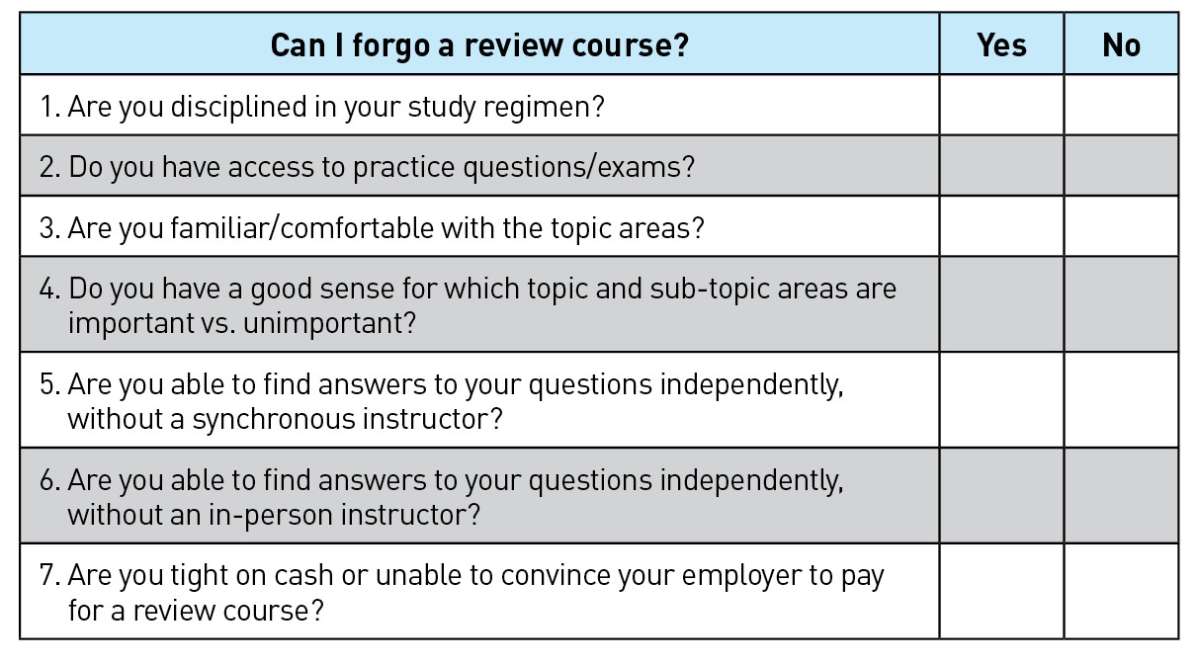
Lastly, CIH candidates often ask, “Should I take a review course?” There is no one-size-fits-all answer. I developed a basic questionnaire, shown in Table 2, to help future CIHs decide whether they might benefit from a review course. If you answer yes to most of the questions, then you can probably skip a review course. However, make sure you have access to practice exams.

If you answer no to most of the questions provided in Table 2, then a review course would probably benefit you. Personally, I took a review course because I answered questions 1 and 4 with resounding no’s, wanted a third party to hold me accountable for my studies, and felt that my additional investment would increase both the stakes and my level of commitment.
Your answers to questions 5 and 6 in particular will help you determine whether you should opt for an online asynchronous course, online synchronous course, or in-person course. Obviously, your schedule and financial situation will play a role in choosing what is best for you. There are many good CIH exam review courses out there, each with their own advantages and disadvantages. As with any major decision, do research and ask for feedback from graduates of the courses. If you take a review course, plan so that you will complete it no more than 90 days before your scheduled CIH exam date.
Like running a marathon, becoming a CIH will not be easy. It will take a lot of paperwork, planning, practice, and preparation, and there will probably be no convenient time for you to study or take the exam. However, you can and will become a CIH.
Written by
Rustin Reed, PhD, CIH, CSP
Instructor
Dr. Reed is a Certified Industrial Hygienist, a Certified Safety Professional, and an educator whose professional and research experiences have focused on industrial hygiene in the mining industry. He manages multi-million-dollar interdisciplinary health and safety research projects funded by NIOSH. His current research interests include diesel exhaust, heat strain, evaluation of safety training, and the use of machine learning to improve safety and health. Rustin served as the Chair of the AIHA Mining Working Group and the Secretary of the Arizona AIHA Local Section.
Read more from Dr. Rustin Reed, PhD, CIH, CSP on LinkedIn.
The views and opinions expressed in this article are those of the author and do not necessarily reflect the official policy or position of Bowen EHS.